Thursday, March 31, 2011

Yoga Journal Talent Search - Vote! Vote! Vote!

Yoga Journal is holding a Reader's Choice Talent Search. To quote their website: "The top five finalists will win new stylish yoga gear from Athleta and the winner will be flown to San Francisco for a photo and video shoot to be featured in our September 2011 issue."

You know I'm no stranger to Yoga Journal or to taking piles of yoga pics, so I entered! If you like my blog, or my photos or my yoga advice... or just my hair... anything... Please take the time to give me your vote! Remind your friends to vote, help the technologically challenged vote - whatever. Just Vote for Me!

Here's a link to my page/submission:


Simply choose 5 red stars and then click "Rate" to submit your vote!
You can vote once a day, every day until April 15th

Wednesday, March 30, 2011

What's Up with Getting Grounded?

This post is Part 2 of my Q & A with Leah!
Leah says: "I was also wondering if you could tell me what exactly is grounding...I heard it in class a few times but I'm still not sure what or why we need to do it or what poses qualify as grounding and why."

Grounding is an interesting and surprisingly complex topic. I'm glad you asked because it's something I struggle with in my own practice. I even did my Final in teacher training on it. (Teach a short class of 4 poses with a theme integrated throughout) Technically my theme was "In the face of chaos seek steadiness/reliability" and grounding poses were how I taught it, but I digress. This post was going to be really long, so I chopped it up into incomplete sentences and whatnot.

Grounding is rooting = becoming one with the ground to become more stable. Like a tree - with all those roots digging deep into the ground they are super-grounded. When you "ground" you root your energy down, which helps you feel physically strong and mentally clear.

Grounding helps stabilize your energy and emotions. It keeps you steady and calm.
Rooting down in a pose allows you greater height/length to reach Up.
Synonyms to help you find more grounding things: Support, strength, solid, firm, pressing.

Examples: Warrior poses, chair pose, bridge, hero pose, child's pose, squats like garland pose, staff pose, seated forward bends. Just about any standing pose with both feet on the earth, hip openers, seated poses, just about anything keeping you close to the ground.

Things that are NOT grounding: balancing poses (especially if you're standing on one leg), inversions (you have to root down, but then down is up), being a flyer in Acroyoga, too much flow - if you don't spend enough time being still the energy is too frenetic to ground you, flying in planes - even the floor isn't stable, being carried.

This is the final section of Leah's questions from the weekend, but don't forget that I am always accepting questions. I do loooove getting them.

Tuesday, March 29, 2011

Backbend Work - In Pictures

Yesterday's post was really chatty, so here's the Show part of all that Tell. Poses to work on if you want to improve your backbends. Almost every pose I mentioned yesterday is here.


Monday, March 28, 2011

Great Backbends in Unexpected Places

Reader Leah wrote in this weekend asking me some great questions that I think everyone should hear the answers to. Leah says: "I have to say that you have great back flexibility!! I was hoping you could tell me some poses that I could practice to help me with mine."

Absolutely!
First, some tips: Bring "heart opening" to just about every pose you do. Make sure your shoulder blades are back and together so they "support your heart from the back". This will allow a greater lift in your chest that is supported into a safe even expansion. Do this all the time and every pose will be a backbend. If you do nothing else - your backbends will already be better. And no matter what backbend you're doing - focus on more length in your torso to keep from compressing vertebrae.

Everyone's lower spine is generally hyper-mobile (weak and flexible like a baby) which can lead to injury without stabilization. Upper spines are usually more stiff so you have to focus on softening it and getting some movement there. Remember that your spine isn't alone in a backbend... the front of your body must be opened up and the back of your body must get strong. More specifically - stretch your hips, quads and chest to open them up for backbends. Work on strengthening your hamstrings, feet, and back to prepare them for the work that must be done to safely engage in backbends. These are some key things to choosing what poses work best for addressing any issues that might be holding you back.

Obvious backbends: cobra, locust, bow, bridge, camel, dancer, pigeon pose, and upward bow.
Less obvious: lunges, mountain pose, and half frog pose. Explained Below.
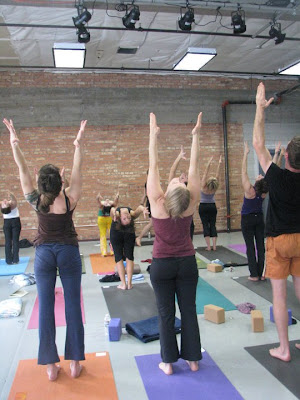
Lunges: I took a workshop on deep backbends last year that was almost 3 solid hours of lunges. Stretch and open the quads/hips of the back leg. They allow you to practice tucking your tailbone, puffing your kidneys (drawing the lower ribs back so they don't poke out in front) and lifting your heart. Take a little backbend and you've got the whole package. Want to step it up even more? Do an arm variation that opens the shoulders like eagle arms or cowface arms. You can even bring the back knee to the floor and draw the back foot toward that same side hip. YIKES! It will take quad/hip opening to a whole new level. It may make you want to cry, but it will improve your backbends exponentially if practiced regularly.

Mountain Pose: Really. Mountain pose is the mother of all poses. You can work on anything in mountain pose. Rooting through your legs? check. Tailbone tucking? check. Puffing kidneys? check. Shoulders back? check. Lifting your chest and doing a small standing backbend while extending your neck instead of collapsing it? check check and check.

Half Frog Pose (variation on Sphinx Pose): Chest forward, sides long, shoulders back, quad stretch, and asymmetrical work - it's a big ol' funky backbend. Asymmetrical work teaches you which side is stronger or tighter and where you can work on balancing your body.

More Q & A later this week, and a more photo-oriented post about backbends tomorrow.
If you need further information on any poses mentioned here: (I think) you can find them all Here.
Today's pics were taken at the Noah Maze workshop in Boise by one of the Boise Kula members. Check them out on Facebook.

Friday, March 25, 2011

Downward Facing Devereux

I'm feeling a little blah, so here's a lazy Friday post of me doing a sacral massage and my Devereux showing off his Downward Facing Dog aka Adho Mukha Svanasana on my old yoga mat (in an old picture).

Thursday, March 24, 2011

Tread Lightly

If you do any form of vinyasa yoga there's a good chance you're going to be asked to "hop forward" or "hop back" into our out of some pose eventually. Sometimes it's a hop back into chaturanga, or hopping forward into a forward bend (standing or seated). Maybe your practice is crazy cool and you hop forward into eyeball defying arm balances. Either way - there's a reason people often use the word "hop" rather than bound, leap, or explode.

Hopefully with everything you do in a yoga practice, but especially in these transitional bouncy actions, you should ideally be seeking some level of grace or lightness of being. This is not happening at all when you throw yourself haphazardly forward with a loud "BOOM" that shakes the floor. It's harder on your bones (it might even break a couple if you're truly unlucky) and it sets up all the wrong tones for your practice. It also might scare the bejeezus out of your neighboring practitioners and that's not very nice.

How do you step lightly in yoga? Draw in toward your midline... pull inward and upward with your core. If everything is moving in and up, it's unlikely to fly apart at the seams and come crashing down. At first this might be hard. At first you might fail miserably - but that's why it's called practice.


Just so you know... I don't hop into arm balances. I wish I could, but it's not in my bag of tricks. Yet.

Wednesday, March 23, 2011

The GURU Principle

GU = Darkness, RU = Light
Therefore your Guru leads you "Out of the Darkness & Into the Light"

Just a little food for thought.